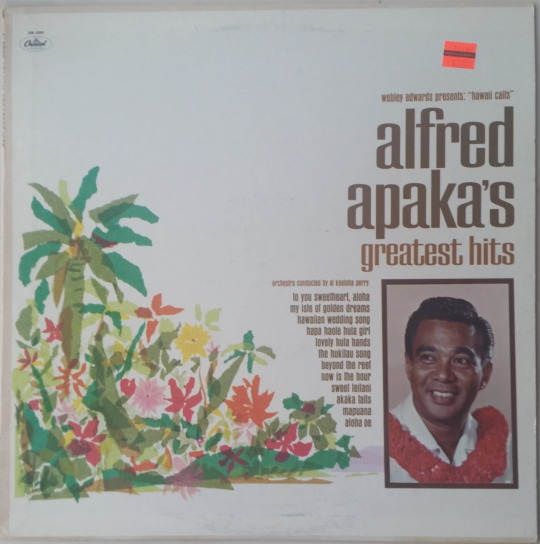
Webley Edwards presents Alfred Apaka’s Greatest Hits by Alfred Apaka and Orchestra conducted by Al Kealoha Perry
Capitol Records, 19??
FRONT COVER
1. To You, Sweetheart
2. My Isle of Golden Dreams
3, Hawaiian Wedding Song
4. Hapa Haole Hula Girl
5. Lovely Hula Hands
6. The Hukilau Song
7. Beyond the Reef
8. Now is the Hour
9. Sweet Leilani
10. Akaka Falls
11. Mapuana
12. Aloha Oe
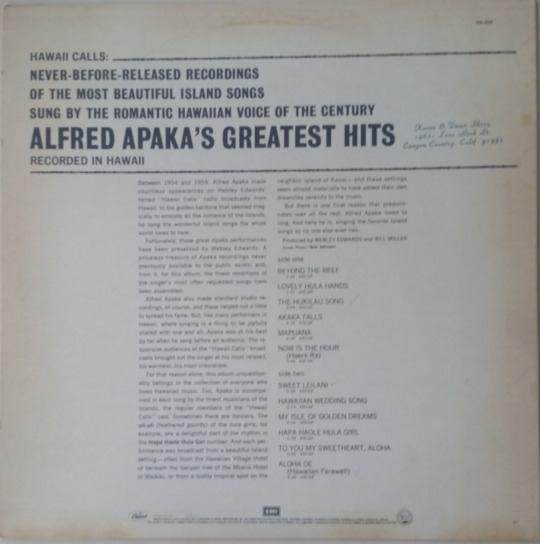
BACK COVER (actual tracklist)
A1. Beyond the Reef
A2. Lovely Hula Hands
A3. The Hukilau Song
A4. Mapuana
A5. Now is the Hour (Haere Ra)
B1. Sweet Leilani
B2. Hawaiian Wedding Song
B3. My Isle of Golden Dreams
B4. Hapa Hoale Hula Girl
B5. To You My Sweetheart, Aloha
B6. Aloha Oe (Hawiian Farewell)
It’s funny to have nostalgia for music you have never heard before. When I grabbed this record over ten years ago, I had no idea, aside from a loose association between Hawai’i and ukuleles, what this would sound like. When I actually gave it a listen, I am not ashamed to admit that SpongeBob SquarePants immediately came to mind. Sound memories are often considered stronger than that of the other senses, and the resonant feeling Alfred Apaka’s Greatest Hits gave me was indeed disproportionate to the relationship I actually have with said record thanks to the potency of childhood.
I guess I should clarify that I probably have heard one or two of the songs featured on this record before, though thankfully in better quality or an entirely different rendition. The crackling on my wax copy is distracting, far beyond the reputation old records have for such warm accompaniment. I can’t remember if this is a new problem, or one I didn’t notice when I first listened to it. This was one of the earliest LPs I found after digging in the dollar crates when I began collecting. I remember being interested in adding a dose of sunshine to my collection, as well as something that felt classic without being boring or predictable.
Now the memories I have of Alfred Apaka are compressed and layered like a funhouse mirror in my mind. Childhood persists, for example, through flexing notes that brush up my pre-established love for Lilo & Stitch, mixed with the joys of music discovery I had when I brought the record home, culminating in writing this article to revive my vinyl diary. And that still pays dividends because even these essays provide me with puzzles to solve.
I wouldn’t say that this is a mystery worth, say, starting a podcast over, but nevertheless, I loved learning about the inconsistencies of this record’s existence. Apaka’s career began in earnest in the late forties, when he and his band traveled the west coast of the States, already having established himself as a local legend back on the islands. In about a decade, he earned his way to national treasure, with numerous residencies and radio performances driving his popularity. In fact, he frequented Webley Edwards program, Hawaii Calls, which had a global audience. When Apaka passed away in 1960, Edwards’ team wasted no time in arranging production of this Greatest Hits record. As this is credited as a presentation of the radio host, it features previously-unheard recordings from various venues across Hawaii.
But when was the time when these recordings were unheard? The first time this record hit the shelves was in 1964 in the UK, US and Canada under Capitol Records. Each country had its own cover art, with small differences of logo placements and details about the playback (mono or stereo). Then there was another pressing in the US in 1967, and from the covers I was squinting at on Discogs, I found no differences between it and the 1964 original press. Nor on the 1969 US repress. But the copy I found at Amoeba Hollywood is none of these, with no markings about playback. It was printed in the U.S.A. but no year is provided. I want to assume that this was printed in a mass repress much later, therefore no longer requiring the declaration of Stereo or Mono. I believe this copy was of the same print as mine, down to the etchings on each side. This was also likely from the same pressing, and mentions the number in the bottom-right corner on the back: they have a 17 and mine says 20.
I won’t delude myself into thinking that I have some special wax, but I am entertained by it nonetheless. Even though I can barely listen to the music anymore anyway, I probably won’t get rid of Alfred Apaka’s Greatest Hits. Not while the paint dries on my newest memories with it.
 Sawdust & Gin